by Cyril Reinicke and Denise Scatena
Cultural anthropologists have long been fascinated by their study of how groups of individuals organize themselves to accomplish necessary tasks and how citizens respond to seemingly everyday challenges.
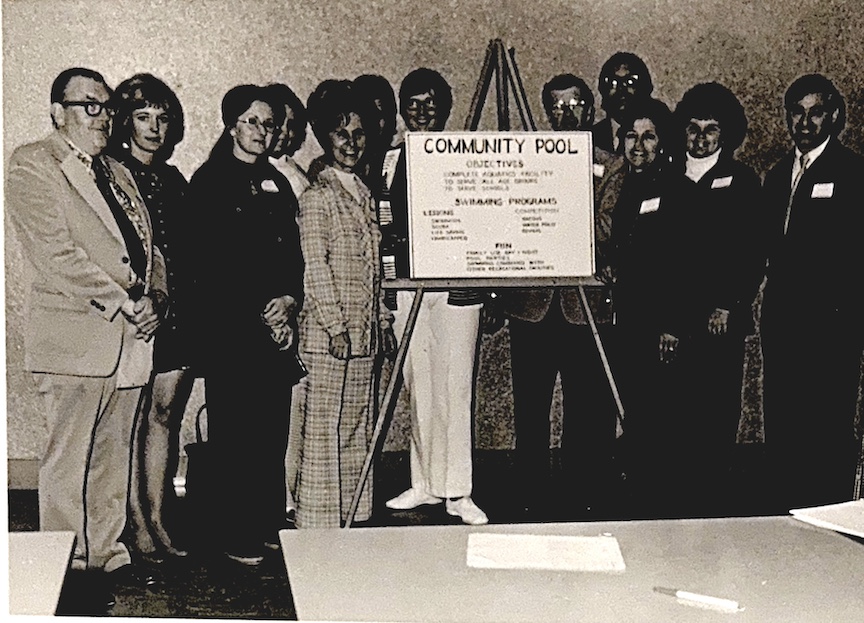
The singular achievement of building the Clairemont Pool in the mid-1970s is one such example for cultural anthropologists to examine further. Recognizing the need for a municipal swimming pool in Clairemont, 20 residents banded together to form the Clairemont Swimming Pool Committee, dedicated to building a large aquatics facility for the community’s 90,000+ residents that was to be professionally staffed, provide water safety instruction, offer a variety of aquatic programs, and be accessible for swimmers with disabilities.
Last year, the Clairemont Pool Booster Club, a volunteer-led group to support the pool serving kids and families in the Clairemont area and surrounding neighborhoods established in 2023, was recently gifted a treasure trove of scrapbooks filled with photos, speeches, newspaper clippings, flyers, letters (and even bumper stickers!) from the daughter of the woman who led the 4-year effort to bring a public pool to our community. We have pledged to keep these historical items safe for her and share this story with a wider audience. These items informed the story we will share here, as there are virtually no records of this community effort available for research and learning. It’s a great case study of community advocacy.
Margaret Meade, the acclaimed cultural anthropologist, said it best, “Never doubt that a small group of thoughtful, committed, citizens can change the world. Indeed, it is the only thing that ever has.” Soon you will meet Molly Simental, chairperson of the Clairemont Swimming Pool Committee, whose grit and determination resulted in building the Clairemont Pool, located at 3600 Clairemont Drive in San Diego, California.
Before we can jump into the story of how the Clairemont Pool came to be, we need to go back in time to learn about the history of our community itself.
The Clairemont community was the epitome of post-WWII America
Clairemont, a large community within the City of San Diego, has a rich and memorable history. Clairemont started as a vision in the minds of two San Diego developers, Carlos Tavares and Louis C. Burgener. Tavares, a civil engineering major from Notre Dame University, and Burgener, a business economics major from the University of Utah-Salt Lake teamed up in 1950 to make their vision of Clairemont a reality: acquiring land, seeking design ideas, and input from land planning engineers throughout the United States and commissioning architects to design high-quality homes and apartments with a variety of floor plans.
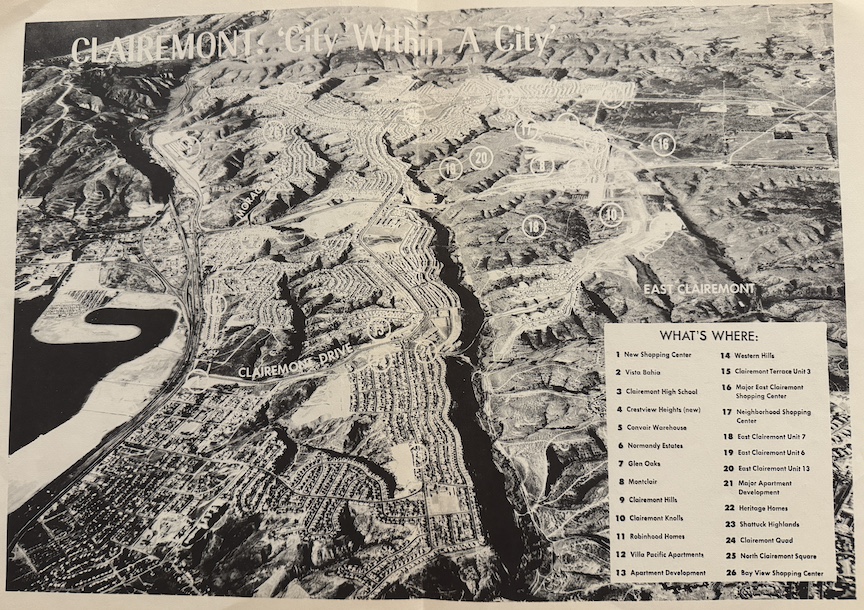
From 1950 into the early 1960s, thousands of homes were built, hundreds of businesses opened, and three shopping centers were dedicated. Fire stations, schools, post offices, and community parks were plotted on the early maps.
This early Clairemont started as a consolidation of unfamiliar locations: Morena Mesa, Hollingsworth Estates, Peavy Ranch, Mission Bay Heights, and Tecolote Heights. The Clairemont of today includes more familiar names encompassing residents bordering Linda Vista from the south, north to Highway 52, on the east is Highway 805 extending west to the edges of Mission and Pacific Beach.
Clairemont was a new community with hundreds of new homes filled with thousands of new residents. Neighbors had the chance to create and nurture the emerging character of their neighborhoods. A focus zeroed in on activities for youth. Starting with Cub Scout and Girl Scout troops, Little League and softball teams, and school PTAs. Business networking groups and associations began to sprout. These would later grow into Town Councils, Chambers of Commerce, Kiwanis, Rotary, and other civic organizations.
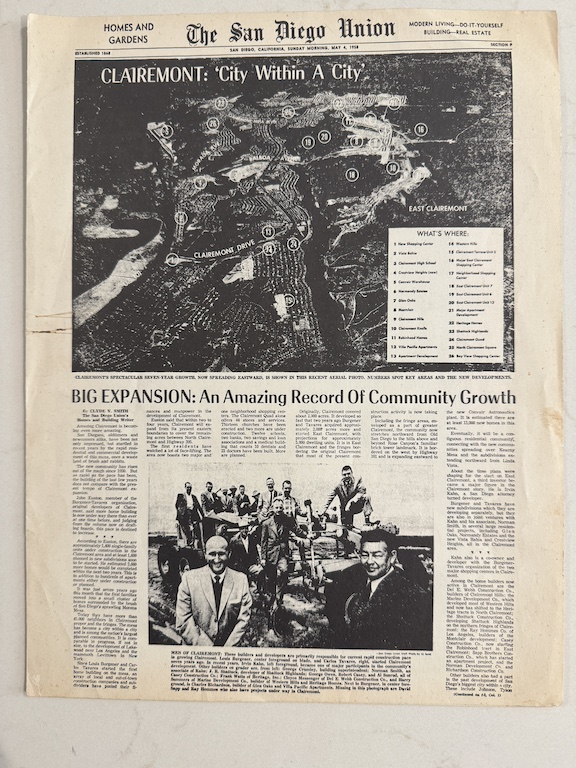
Neighborhoods expressed the need for additional amenities such as pools, playgrounds, senior centers, and more. Enter Amelia “Molly” Simental, an early Clairemont resident living on Bellvale Ave. near Madison High School. She became a formidable community activist in pursuit of publicly funded swimming facilities for Clairemont.
Clairemont was almost given a multi-use ‘Pie-Pan Shaped Pool’
Molly’s fastidious record-keeping gives us insight into her three-year and four-month quest to bring recreational swimming pools to Clairemont, beginning with the establishment of the Clairemont Swimming Pool Committee in November 1974. The committee, which consisted of neighbors and influential community members was specifically focused on “acquiring swimming pools and facilities for aquatic activities. The facilities should be a senior Olympic multipurpose pool, to serve the young, the old, and handicapped.”
The motivation for the creation of the Clairemont Swimming Pool Committee and to initiate a vigorous lobbying campaign for a full-size pool was a response to an earlier effort by then San Diego City Councilman Bob Martinet to build a “pie pan pool” – designed as multi-use, shallow, and round-shaped cement structure measuring 72 feet across in length and only 42 inches deep. When not used for “swimming,” it could be drained for roller skating, dances, and even model car racing.
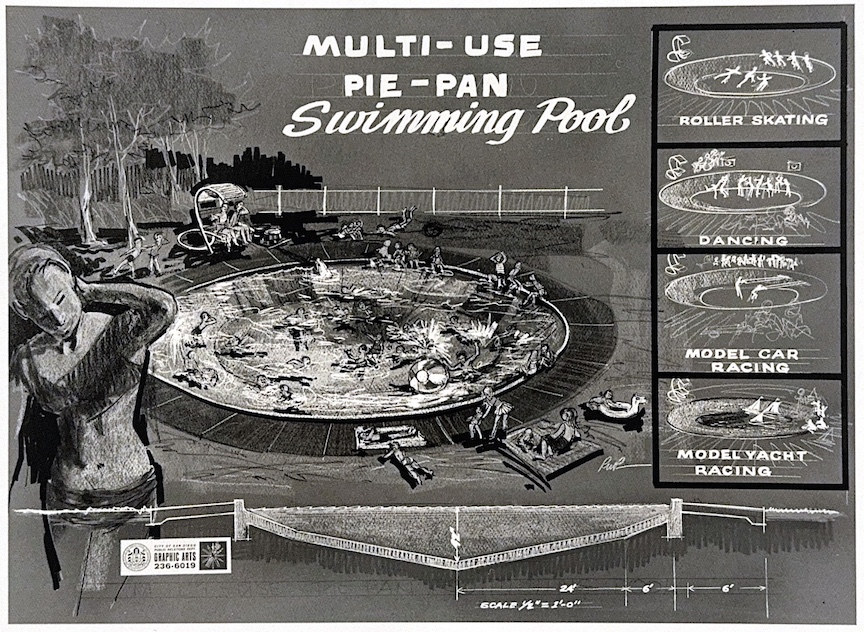
Among the twenty original pool committee members were four women – Molly Simental, Clio McCuen, Marilyn Hoagland, and Joyce Hauck – who took on the task of engaging the City of San Diego and San Diego Unified School District leadership, keeping a focus on the Committee’s goal to build a full-size pool in Clairemont to allow for swimming competitions, lessons for local school children, and general physical fitness. The Pool Committee conducted a great deal of research for swimming pool design ideas, identified funding sources, and built tremendous community support. The pie-pan pool idea was scrapped, and the journey continued to build a full-size aquatic facility for Clairemont.The committee consisted of twenty area residents formalized with officers, regularly scheduled meetings, agendas, and published minutes. Regular and ongoing progress to the community was reported in The San Diego Evening Tribune, and The Clairemont Sentinel, along with updates in Madison High School and Clairemont High School’s PTA newsletters and church bulletins. The pool committee also had its own newsletter.
Community advocacy (without the Internet)
The community advocacy effort initiated by Molly and the members of the Clairemont Swimming Pool Committee was a monumental challenge, especially in a time without computers, WiFi, or smartphones. They created flyers, organized in-person meetings, held one-on-one conversations, and embarked on letter-writing campaigns (not emails.) The scrapbooks and files show a remarkable effort, to coordinate and mobilize the community and future pool users.
The first community meeting was held Dec. 9, 1974 in the auditorium of Einstein Jr, High School (now CPMA) on Conrad Street, and featured formal presentations from Madison and Clairemont High School swim coaches, and representatives from the American Red Cross. High school students themselves made presentations on the clear need for a pool to improve high school aquatics programs. City Council and school administration were present to listen to and discuss the community’s desire for a pool and understand that the community resident’s number one priority was an Olympic-sized pool. As a result of this meeting, the “pie-pan shaped pool” was rejected.
San Diego Unified School Board Member Julie Fischer suggested the committee and legislative officials look at the idea of school and city funding and joint use by citizens and school children. In the Dec. 11, 1974 edition of The Clairemont Sentinel, it was reported that “a tax of up to 10 cents may be levied by the school board for use in community projects such as tennis courts and recreation centers.” Ms. Fischer explained the community service tax (CST) could potentially raise $1.5M to $2M if levied in full. Prior years saw the tax levied at 3 cents and the money used for tennis courts paid for by the district with the city installing and maintaining the lighting.
The unanimous consensus from the Dec. 9 meeting was that the number one priority of Clairemont residents was a cooperative effort between the San Diego Unified School District and the City of San Diego to build and maintain a swimming pool in Clairemont. In a letter from pool committee secretary Marilyn Hoagland, dated Dec. 21, 1974 to County Supervisor Lou Conde, stated: “This letter is to inform you of actions taken by Clairemont residents to make the construction of community swimming pools the number one priority in the San Diego area.” School board, city council members, and park and recreation administrative staff were deluged with letters from the community, in a campaign led by Hoagland, She writes: “We are making an all out effort to coordinate the City, City Schools, Park and Recreation and County agencies to make them aware of our community’s needs.” The pool committee also pledged to raise $100,000 from the community itself to offset the estimated $600,000 pool cost. The committee embarked on a fundraising campaign shortly after.
Committee members conducted extensive research on design and funding options
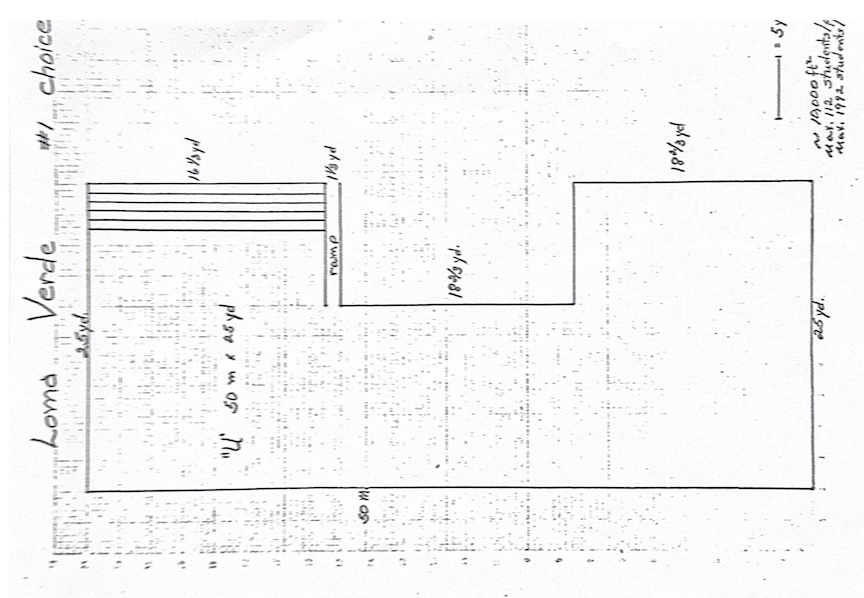
By May 1975, the pool committee focused their efforts on persuading the City, the school district, Park and Recreation leadership as well as the County Board of Supervisors to adopt and implement a community service tax. The Clairemont Swimming Pool Committee published an 11-page open letter to the community at large and to the above agencies detailing their nationwide research on minimal community swimming pool standards including guidelines for publicly owned pools’ purposes, safety features, and three actual design layouts complete with perimeter measurements.
This comprehensive report also included the “load” for each pool design for recreational swimming, instructional swim lessons, and competitive swim meets. “Clairemont is the largest community in San Diego City with a population of 97,000 people. The Clairemont Pool Committee feels a combination of 2 basic pool sizes is needed: the 50-meter multi-purpose pool and 25 meter by 25 yard instructional pools.” This design was identified as the Loma Verde (or U-shaped) pool as the pool committee’s top choice. The report went on to explain that all community pools needed “to be centrally located in high-density family locations with good public transportation available.”
Community Service Tax (CST) becomes point of contention among local leaders to fund pool construction
During 1975, the Clairemont community saw steady, yet at times uneven, progress among school, City, and county agencies to coordinate the understanding of how the joint funding and maintenance would work when building community pools. Hashing out an acceptable level of the community service tax provoked ongoing discussions among school board members. The school board had held the CST at 3 cents in previous budgets and was opposed to levying the full 10 cents option.
In July 1975, Molly made three presentations to the Park and Recreation Board as they discussed the exact location of the Clairemont swimming pool and formulated their funding recommendations for future city projects. The initial location for the Clairemont Community Pool was to be at the North Clairemont Recreation Center on Bannock Street, but the recommendation shifted to the land adjacent to Marston Jr. High, and the South Clairemont Recreation Center. Notes from Nan Valerio’s August 1, 1975 school board presentation, representing the Clairemont Town Council, described Clairemont residents continued to lobby the school board to include joint-use community swimming pools in their community assessment tax levy.
Funding secured for Clairemont Swimming Pool
Finally, in Sept. 1975 came some good news. An article in The Clairemont Sentinel announced: “Chuck Glenn, head of the school district’s business services, says money has been set aside $600,000 in the 1975-1976 budget for planning and construction of two pools: one at Marston Junior High in Clairemont and one at Lewis Junior High in Allied Gardens. Both pools are located on city property and will be shared by the public and the nearby junior high schools. The money will come from the revenue of a five-cent community service tax.”
As with any large construction project challenges and delays were inevitable. Continued planning addressed the fronting of the pool onto Clairemont Drive, a parking lot design, and the creation of added safety features along Clairemont Drive for both motorists and pedestrians as they use the pool. The pool fees were also a matter of concern for residents and city officials as well.
Clairemont Pool officially opens Feb. 24, 1979
As the pool neared completion, an informal “soft” opening in January 1979 addressed operational challenges before the official opening festivities scheduled for February 24, 1979. The two-hour ceremony included a presentation by a Boy Scout color guard group, speeches from community and elected officials, as well as an aquatics demonstration of diving and synchronized swimming. A special presentation highlighted the dedication. Mrs. Clio McEuen, the historian of the Clairemont Pool Committee, presented Molly Simentel with an engraved pie pan that read, “To Molly, Many Thanks. Clairemont 2-24-79” to remind everyone how far the pool committee had come from San Diego City Councilman Bob Martinet’s early suggestion of a pie-pan shaped community pool.
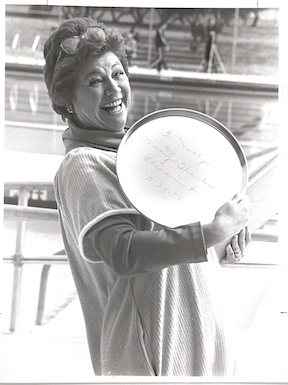
Accolades to Molly for her persistence and dogged determination in getting this pool built were frequently heard in remarks during the dedication. As reported in the Feb. 28, 1979 edition of The Clairemont Sentinel, City of San Diego Councilman Thomas Gade remarked, “The only individual responsible for the pool is Molly.” San Diego County Supervisor Roger Hedgecock echoed, “Other communities can learn what was done here by Molly and others.” Molly’s response? She kept it simple.“Please enjoy your pool. I love you. Thank you.” Later that afternoon, the Clairemont community was welcomed to free swimming from 12:30 p.m. to 4:00 p.m.
Clairemont Pool continues to serve the San Diego community
Today, the Clairemont Pool is a major anchor of our community. It is home to high school swim team and water polo programs, as well as a successful youth recreational swim and water polo program for younger swimmers. The pool bustles with swim lessons, lap swimming, recreational swimming, and water exercise classes. The joint-use legacy lives on, with an active agreement to coordinate swim lessons for Marston students, and is host to the Clairemont High School swim and water polo teams. Current pool hours of operation and available programming can be found here.
Generations of Clairemont residents swim, splash, and play at this full-size pool, that may not have come to fruition without the wherewithal of one person, Molly Simental.
Molly’s legacy lives on in the newly formed Clairemont Pool Booster Club, which collaboratively works with the City of San Diego, designated community groups, and pool users to advocate for the pool and its programs. Learn more at www.clairemontpoolboosterclub.org.
 Clairemont Pool Booster Club